Updated Tuesday 19 May 2026.

Premium updates for 2026-27

For all policies issued or renewed on or after 30 June 2026.

Workers Compensation premium rates for 2026-27

The Workers Compensation Legislation Amendment (Reform and Modernisation) Act 2026 introduces a premium rate freeze for 26-27 and 27-28.

The 2025-26 Workers Compensation Industry Classification (WIC) rates will be maintained for the 2026-27 policy period.

Premiums may still change due to:

  • changes in wages
  • changes in business activity
  • an employer’s own claims experience.
  • incentive eligibility.

Further details on WIC rates are available in the Frequently Asked Questions below.

Minimum premium

The minimum premium payable for a policy will remain at $240.

Experience-rated capping

To help maintain stability, premium-increase capping for experience-rated employers will reduce from 30% to 25%.  

Employer-paid claim excess

The reforms introduce an excess that employers must pay at the start of a claim. In response to this, the cost of an individual claim for premium calculation purposes may be reduced by any employer-paid excess amount.

Loss Prevention and Recovery Plus

icare have introduced a maximum premium of 5.985 x Average Performance Premium (APP) for LPR Plus policies, providing greater certainty for participating employers.

Safe Employer Reward (SER)

Introduced 30 June 2025, but effective from 30 June 2026, SER eligibility includes timely submission of actual wages declaration forms for prior policy periods (in addition to existing performance criteria).

Visit the Declaring wages page for further information and support.

Frequently Asked Questions

These Frequently Asked Questions (FAQs) answer common questions about Workers Compensation premiums.

  • In response to reform, the Workers Compensation Industry Classification (WIC) rates have been held for the 2026-27 period. However, premiums are calculated using multiple inputs and may change due to:  

    • change in wages 
    • change in business activity  
    • the employer’s own claims experience  
    • incentive eligibility, for example Safe Employer Reward.
       
  • The risk of getting injured varies for people working in different industry sectors. To charge a fair amount to each industry, icare's premiums need to reflect that risk. Each industry is given a classification rate based upon that level of risk - a Workers Compensation Industry Classification Rate or WIC - which is based on the actual safety performance of the industry.  Every employer’s business is given a classification (WIC) based on their predominant business activity.

    An employer's premium starts with a calculation multiplying their company's wages by their WIC rate. Every year, all WIC rates are revised to reflect the recent past performance of each industry.

    Find out more on the Workers Compensation Industry Classification WIC System and Premium Rates page.

  • To help keep premiums stable for experience-rated employers, premium capping will reduce from 30% to 25% for experience-rated employers whose policy period commences on or after 30 June 2026.

    Premium capping prevents an employer's premium rate increasing more than 25% above that of the prior year’s premium rate.

    Premium capping only applies if the increase is caused by the employer's own claim costs or a change in the premium calculation method.

    Premium capping does not apply if the increase is due to a change in the employer's wages or a change in the employer's industry that leads to a different industry classification.

    Premium rate decreases will remain limited to 30%.

    For more information visit What is premium capping and how does it work?

  • For employers where claims experience is used to calculate a premium, any employer-paid excess amount may be removed from the cost of claim when calculating the premium.

    Please visit our Reforms page to understand more about the new excess provisions.

  • icare aims to reward businesses that create safer, healthier workplaces in NSW. The Safe Employer Reward (SER) is a performance-based incentive offered to employers who demonstrate a strong safety record and good claims performance. It can lead to a premium reduction at policy renewal.

    In addition to the existing performance criteria, SER eligibility has been expanded to include timely submission of actual wages declaration forms for the prior policy period.

    Employers that meet the performance criteria but have outstanding wage declarations will not receive the SER.

    Learn more about the Safe Employer Reward (SER) and how to submit wage declarations.

  • The most important thing for all employers to be aware of is that premium costs overall can only be kept down if employees are working in safe, healthy, injury free workplaces.

    icare offer a range of incentives, rewards, and other adjustments to help businesses in NSW lower the cost of their insurance premiums, including a discount for payment in full, on or before the due date.

    Please see icare's How to lower your workers insurance premium page for further details. 

  • If an employer's annual average performance premium is $1,000 or more, they can pay their premium in monthly instalments. This helps employers manage their costs over time. icare gives a discount for annual premiums that are paid in full, on or before the due date.

    Find out ways to reduce your premium.

  • When it's time to renew your Workers Compensation policy, you're legally required to declare the amount of wages paid within your business during the previous policy period. This means we can calculate a fair and accurate premium for you.

    Depending on how much you’ve paid in wages during the previous policy period, your premium for the current policy period may be adjusted, and you may need to make an additional payment, or you could receive a refund.

    Failure to declare your actual wages on time may result in your estimated wages for the next renewal being increased by 30%.

    Find out how to declare your wages

  • Actual wage declarations are an important tool for delivering greater fairness and accuracy in premium calculations. A 30% wage loading is applied to any renewal calculation where the employer has outstanding actual wage declarations for expired policy periods.

    Eligibility for the Safe Employer Reward (SER) includes the submission of an actual wages declaration form within 4 months of the policy period expiring. 

    All employers are encouraged to take the steps to submit actual wage declarations on time to support accurate premiums. Employers that meet the performance criteria but have the ‘most recently due’ actual wage declaration outstanding, will not receive the SER.

    Find out more about Declaring wages.  

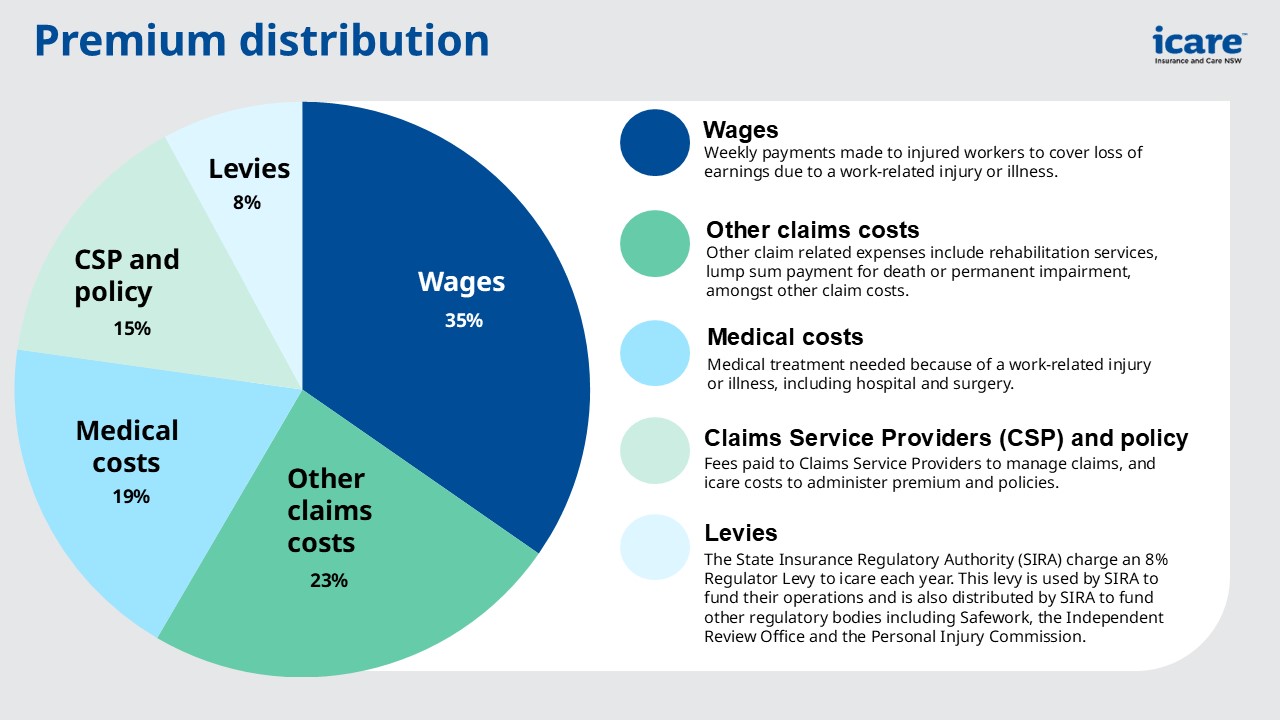
  • Workers compensation premiums are distributed to cover wages that include weekly payments made to cover loss of earnings due to a work-related injury or illness, other claims costs like rehabilitation services, medical costs including surgeries and hospital visits, fees paid to Claims Service Providers who manage claims and levies paid to regulatory bodies.

    See how premiums are distributed.

  • If you are a large employer, that meets specific criteria, you may be eligible for one of icare's Loss Prevention and Recovery (LPR) products.

    From 2025-26, an enhanced formula was introduced to the LPR minimum premium. This means employers with the best health and safety performance pay lower minimum premiums to better reflect their risk.

    You are considered a large employer if:

    • your average performance premium exceeds $500,000 for a 12-month period of insurance (this can be pro-rated for shorter periods of insurance), or
    • you are member of a group of which at least one member's average performance premium exceeds $500,000.

    LPR Plus is designed to meet the needs of the largest and most sophisticated employers in the workers compensation scheme with an Average Performance Premium (APP) greater than $3 million.

    If you think you qualify for either of these products, please visit our Loss Prevention and Recovery Products page.

  • Employers can contact icare's Underwriting team on 13 44 22, or via Live Chat.

Premium review or disputes

We understand you may have questions about your premium. We are here to help.

What can you do?

Contact your Policy Team directly, or on 13 44 22. Here’s what you can expect from the support we provide:

Understanding and guidance

  • If you don’t understand how your premium was calculated, we’ll go through the details with you and explain it in plain language.
  • We will check we that we have the correct information about your business
  • If you need help with paying premium, we can arrange for a premium collections team member to reach out to you to discuss a payment plan.

Timeframes

  • If we can’t help you on the spot, we’ll let you know how long it’s likely to take. In most cases, this will be between five and 21 business days.
  • You will be given a case number to use when contacting us.
  • We will stay in touch and let you know if there are any delays.

How we resolve premium disputes

We use a consultative dispute process which means we work with you to resolve issues.

During this process:

  • We’ll provide guidance to all parties involved on what information we need
  • We’ll explain what actions are required to helps reach a resolution.
  • We’ll keep you informed of our progress.

If your premium concern can’t be resolved and you need to move to a formal appeal*, we will start that for you and help you through that process.

*Formal appeals are used when the calculation of your premium is correct, but you feel other factors were not considered or the calculation doesn’t meet SIRA's Premium Guidelines.

What we need from you

  • We’ll let you know at the start of your review exactly what information we require.
  • We ask that you provide us with this information quickly, so we can resolve the issue as efficiently as possible.